
Gear Review:
Roland/ Studio Electronics SE-02 Monophonic Analog Syntheisizer
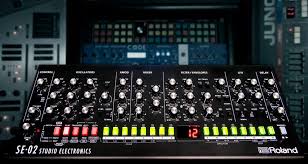
A collaborative effort merging Studio Electronic's SE-1x ( -discrete analog circuitry and signal flow ) with Roland's miniaturization, sequencer and cross-mod acumen. The SE-02 is the first of Roland's Boutique "Designer Series".
( -ABOVE ) THE ROLAND/ STUDIO ELECTRONICS SE-02
CAST your VOTE!
In our "Synth Project" Poll. ATT: Small format Synthesists - be featured in our "Tiny Synths, Mighty Sounds" documentary! *See links below...
Preface:
Having previously owned Roland's JP-08, JX-03 and JU-06 Boutique synths ( -which I've since jettisoned ), I didn't know what to expect from the SE-02. However, as a fan of old-school, one-knob-per-function "reach-out-and-tweak it" analog synths, the SE-02's irresistible knob, switch and button festooned control panel finally lured me into buying it. Since acquiring it I've found the SE-02 to be a "mixed bag" of good combined with a fair amount of "Gee, I wish they'd done that betters". We'll get into both the "goods" and the "Gee, I wished's" in the following review.
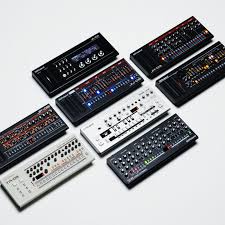
( -LEFT ) A PARTIAL REPRESENTATION OF ROLAND'S GROWING LINE OF BOUTIQUE SYNTHS, DRUM MACHINES and DEVICES...
The ACB ( -Analog Circuit Behavior ) modelling technology used in Roland's Boutique line is fairly decent sounding. Of the aforement-ioned trio of Boutiques, I found the JX-03 to be the best sounding of the lot. So, HOW does the ( newer ) SE-02's tone measure up against these earlier ACB-powered Boutiques? I'd say it "bests them" but ( -somewhat surprisingly ) not by that much. To be honest, the ( -ABOVE ) ROLAND'S BOUTIQUES SE-02 is a bit of a let down. At least in terms of sound quality.
A listing of features:
The SE-02 is a discrete analog ( 3 ) oscillator monophonic synth. Each of it's oscillators sport ( 6 ) waveforms ( -they are: triangle, tri-saw, sawtooth and three pulse-width/ squares -with the last qualifying perhaps as an honest-to-goodness pulse wave ). Oscillator three substitutes a traditional reverse sawtooth for the "tri/saw" wave featured on the other two oscillators -just as the old Minimoog did.
The oscillators are temperature-stabilized and auto-tune for drift free operation. The last time I checked, Behringer's "D" ( -a synth that might be considered a competitor to the SE-02 ), didn't offer this degree of stabilization -requiring owners to manually calibrate it's oscillators before serious usage. However, this may have changed since I received my early-production "D" months ago. Perhaps Behringer has caught on that customers shouldn't have to calibrate things that should be done on the production line. Let's hope so.
"To be honest, the SE-02 is a bit of a let down. At least in terms of sound quality" -Tomm ( CTN ).
Filters, cross-modulation and more...

The SE-02 also features a 24 dB/ octave "Moog-style" low-pass filter with a filter feedback loop ( -for "fattening up" the sound ). You'll also find a dual gain-stage amplifier for adding some additional "character" to the sound. Three types of cross-modulation are provided for ( i.e: 02-Filter, 03-02 and 03-PWM ) and like the filter there's a feedback loop. PLUS a noise generator -to expand your sonic palette even further! ( -ABOVE ) THE SE-02 LOOKING SEXY IN THE STUDIO
LFO, sequencer and such...
The SE-02's tempo-syncing LFO has ( 9 ) waveforms ( i.e: the all-important sine, a triangle, a ramp, a saw-tooth, ( 3 ) square waves ( -of decreasing duty-cycles ) and two versions of "random". There's a tempo-syncing digital delay with "bypass" ( -to maintain the SE-02's pure analog signal path for the purists out there ), along with a generous ( 384 ) factory presets. Thankfully, there are ( 128 ) user patch slots left "open" for those of us who still prefer to "roll our own".

( -LEFT ) THE SE-02's SEQUENCER SECTION ( -buttons at the bottom of the control panel )
There's a 16-step pattern sequencer ( -which can sync to external tempo via MIDI, USB or trigger input ). The sequencer can be used for sequencing notes, gates, glides and other synth parameters -via it's somewhat irksome "step-entry" procedure. ( -ABOVE ) THE SE-02's SEQUENCER SECTION
More sequencer stuff, I/O connectivity and other "sonic goodies"
Patch numbers are stored with each sequence and up to ( 128 ) sequences are storable ( -allowing you to construct longer songs with 16 parts ). Synth parameters can be "sequencer automated" by pressing a step button and then moving a synth parameter control to where you want it -then repeating this process over-and -over again, for as many steps as you want your sequenced parameter automation to last. Frankly, IK Mulit-media's UNO Synth makes doing this is a lot easier ( -and it costs half of what the the SE-02 costs! ).
"Frankly, IK Multimedia's UNO Synth makes doing this ( i.e: "sequencer automation" of synth parameters ) a lot easier ( -and it costs half of what the SE-02 costs! )" -Tomm, CTN.
Sequencer, goodies continued...
The SE-02's sequencer allows you to set shuffle, scale, direction and set your sequnce's first and last steps. Nice touches! Along the unit's top apron you'll find standard MIDI, USB-MIDI and USB-Audio ports along with GRRRRRR! a plethora of slightly protruding ( -flimsy lookimg ) 1/8" mini-jacks ( -for trigger I/O's, CV inputs, an external audio input -for routing external audio through the SE-02's filter, a stereo audio output along with a headphone jack ). Need I mention my disappointment at seeing cheesy 1/8" mini-jacks being utilized for these "mission critical" I/O's? And yeah, I know the 1/8" mini-jack has become the de-facto "standard" for Eurorack and lots of other synths these days but it doesn't make them the optimal choice for signal transmission -especially audio!
I'm sure the folks at Roland and SE will quickly justify their use citing the unit's diminutive size ( i.e: "We couldn't possibly fit full-size 1/4" jacks on a unit this size!" ). However, I'm not sure I'm buying that. I think it's more likely they simply wanted to "cut corners" and use the unit's size as a "ready-made excuse" to save a few bucks. Wake up synth manufacturers! 1/8" mini-jacks ( -especially the dreaded 1/8" stereo mini jack, SUCK BIG TIME! ). They're ALWAYS the first thing to develop signal intermittencies, audio drop-outs ( -and subsequently require replacing ). Employing them on a piece of gear listing for half-a-grand is inexcusable! If you need more mounting room then use a slightly larger chassis so sturdier, proper 1/4" connections can be used! The sequencer's "chain mode" allows connecting additional SE-02's via MIDI.

( -LEFT ) THE SE-02's BACK PANEL.
Notice all of the mini-jacks! One of the SE-02's "Achilles' Heels". How long they'll last before developing signal intermittancies and drop -outs is anyone's guess.
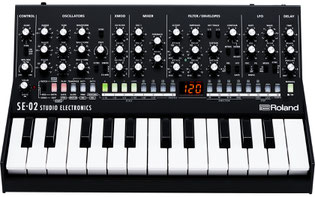
( -RIGHT ) THE SE-02 SHOWN WITH IT'S OPTIONAL K-25m MINI-KEYBOARD.
Beware of the K-25m's ribbon connector. Once it's connected it's there for good!
The K-25m mini-keyboard
I purchased my SE-02 along with it's optional K-25m keyboard. This two-octave mini-key keyboard was specifically designed to work with the Boutique line. Having previously owned the JX-03, JP-08 and JU-06 Boutiqies, the K-25m was old territory. It's pretty much what you'd expect from a $100.00 mini keyboard controller. Stubby mini-keys with a clunky, utilitarian keybed. Nothing special. Certainly, a far cry from the deluxe silky-smooth action you'll find on Yamaha's "ReFace" line or Novation's "Mininova" for that matter.
You connect the K-25m's ribbon controller to a multi-pin receptacle on the back of the SE-02 module ( -just like the other Boutique synths ). A word of caution: Once that connector is attached it's there for good! You won't be able to easily detach it for "mixing and matching" with your other keyboard-less Boutiques. And I say that from experience! I've tried detaching the K-25m's ribbon connector from past Boutiques and broken fingernails in the process. I'm sure Roland's techs have a nifty tool that makes "quick work" of this -but for us mere mortals forget it! Once again Roland makes it as difficult as possible for customers!
"Once again, Roland makes it as difficult as possible for customers!" -Tomm, CTN
The one "saving-grace" the K-25m offers is it's thoughtful three-position locking mechanism. You can position the SE-02's chassis ( -or any OTHER Boutique synth ) at two different tilt angles or set it flat. A nice touch! A release button on the back allows you to disengage it from the flat position -but it can sometimes be a trick to get it to fully disengage. And another word of caution: be careful when tilting it past it's fully upright position ( -because if you go past that position the weight of your Boutique synth can cause it to flop forward onto the K-25m's keyboard! ). Make sure you're cradling your Boutique module's weight in your hand if you need to tilt it past this topmost position -to avoid this unwelcome surprise! ).

( -LEFT ) THE K-25m KEYBOARD/ DOCK.
Showing the bared multi-pin ribbon connection cable and multi-position tilt mechanism.
X-Mods, factory presets and firmware updates
The SE-02's "X-Mod" section allows you to apply cross-modulation ( FM ) in the following ways:
The 02-Filter knob lets oscillator 2 modulate the filter's cut-off frequency. The 03-02 knob lets oscillator 3 modulate oscillator 2's waveform. The 03-PW 1, 2 knob allows oscillator 3 to modulate the pulse-width of oscillator 1 and 2 ( -their pulse waves only ). Apart from the pulse-width modulation -whose functionality has been enhanced with a firmware update ( v1.1 ), the rest of the "X-Mod" section could've been omitted completely and I'd never have miss it! It adds little -save a few abberent tonalities. A waste of control panel space in my opinion.
Luckily, the pulse-width modulation has been improved with v1.1's firmware update ( -though getting it to work using the firmware's "button-press gymnastics" is a bit tiresome ). The unit comes with ( 384 ) factory presets. What can I say -they're "factory presets"! They sound as if the programmer who cobbled them together did so as quickly as he could ( -with many sounding similar to the ones proceeding them ). Nothing inspiring here. I think I found exactly ONE ( # 65 ), that I might actually use - if I were desperate. My advice: program your own -they've gotta be better than any of these!
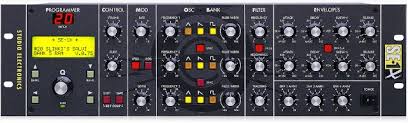
( -RIGHT ) STUDIO ELECTRONICS SE-1x Inspiration for and full-sized forerunner of the SE-02.
Sound-quality
Initially, upon hearing the SE-02 for the first time, most synthesists give it their "thumbs up". I did too! However, within a few minutes of hearing it my initial impression began to sour. I started noticing a certain "sharpness" about it's sound ( -as if everything sounded a semi-tone or two sharper than it should be ). The high frequencies seemed "hyped" and a bit too saccharine for my tastes. At the same time the SE-02's low end seemed a bit "thin-sounding" to me. After many hours of listening to the SE-02 during the writing of this review, my opinion hasn't changed. If you're looking for a synth to emulate those fat, beefy analog beasts of yesteryear -this may not be your synth.
"If you're looking for a synth to emulate those fat, beefy analog beasts of the yesteryear -this may NOT be your synth" ( -Tomm/ CTN )
Proof's in the pudding...
Well into doing this review, I stumbled upon a SonicState review of the SE-02 done by Nick Batt. Near the beginning of his review Nick put the SE-02's raw oscillator waveforms onto an oscilloscope. Upon seeing them I knew where that "saccharine sweetness" was coming from. The oscilloscope trace tells the story!
If you happen to watch Nick's review you'll see what I mean. The SE-02's sawtooth waves sound overly "bright" and "thin" ( -with none of the full-throated sawtooth richness you'll hear coming from many vintage analog machines ). And the SE-02's oscillator's pulse/ square waves tilt at such a pronounced angle the corners of each square appear almost to be sawtooth waves. While Nick found nothing wrong with these distortions - I did! The SE-02's "hyped" waveform peakiness and tilted edges ( -on the pulse/ squares ) are bound to add excess high frequency content to the signal ( -explaining the persistent "saccharine" glaze I was hearing ). This high frequency "glaze" overpowers the low-end content and the ear perceives it as weakened bass or a "lack of beefiness". Again, the oscilloscope tells the story!
Curiously, the triangle waves -while exhibiting some lopsided bowing -fared much better and sounded
the most authentic of the SE-02's oscillator waveforms. And YES, I do understand that few if any synths put out perfectly symmetrical "text-book" waveforms. I also realize waveshapes can be distorted depending upon their frequency ( i.e: appearing more compressed at high frequencies and more spaced at lower frequencies, etc. ), not to mention the effects of filtering, envelopes, LFO modulation upon the wave's shape. However, these were the raw unfiltered waveforms -coming straight out of the SE-02's oscillators! With oscillators being the sonic "heart" of any synth, these distortions are cause for concern -unless you're into thin "hyped" upper midrange and headache inducing highs. After a while, the SE-02's thin ( -bass emasculated ) "hyped" upper mids and highs start to "tense you up". More than once - while auditioning and programming sounds on the SE-02,
I felt the need to turn off the unit. It's sound can literally induce back of the neck throbbing migraines. It did
in me more than once!
( $50.00 ) PAIA "Gnome" vs. ( $500.00 ) "SE-02" !
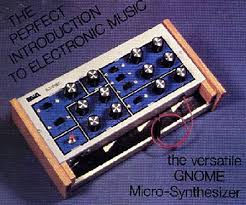
In 1975-76' PAIA ( -a DIY kit company ) debuted their ( $49.95 ) "Gnome" Micro Synthesizer. Being a teenage kid in highschool at the time I bought and built one. The "Gnome" was only intended to be a low-cost educational "toy" ( -to teach budding electronic musicians the rudiments of electronic music ). Despite that, the "Gnome" had a very cool oscillator section with triangle, sawtooth and square waves along with a "skew" control knob ( -allowing you to transform the triangle into a sawtooth wave and the square into a pulse wave ). By manually turning this knob back and forth you could approximate pulse-width modulation of the square wave. A very cool feature for a $50.00 kit synth of the 1970's to have!
More over, the "Gnome's" oscillator section sounded phenomenally good! Especially it's sawtooth wave. It's warm, musically rich, full-throated timbre was an absolute joy to listen to. The very essence of what "analog" should sound like! It's amazing that this $50.00 DIY "kit-built" synthesizer's oscillator section sounds soooooooooo much better than the one employed in the SE-02! At 1/10th of the professionally built SE-02's suggested price, the "Gnome's" oscillator absolutely crushes the SE-02's. By comparison,
the SE-02's oscillators sound downright "anemic"! Who'd have guessed?
Back to the SE-02: Build quality:
The SE-02's build quality is another area of concern. Besides the flimsy 1/8" mini-jacks, I found the unit's tiny knobs "tweezy" and stiff ( -especially it's waveform selection knobs ). Hopefully, this stiffness will work itself out over time. The unit's tiny switches don't inspire much confidence either. They are so tiny and fragile-looking! Whether they'll withstand repeated switching over time concerns me. Ditto that concern for repeated plugging in and disconnection using those already mentioned 1/8" jacks! At this price point, I would've thought that Roland and Studio Electronics could've sourced much higher quality parts.
Frankly, the build quality of the SE-02 worries me. Will I be sending it back for repairs in a couple of months? Only time will tell. I wish I could be more positive but all of these component compromises worry me.
And there's another thing: the operation of the SE-02 isn't what I'd call intuitive, straight-forward or user-friendly, especially the "firmware-updated" features. Be prepared to be glued to the owner's manual for
a while until you master all of the SE-02's "button-press gymnastics". It's almost as if Roland's design team wanted to make things as vexing and irksome as possible for the end user. You even have to follow a specific procedure just to turn the unit on and off! I remember encountering this "turn on" and "turn off" protocol decades ago with my very first Roland product -Roland's MSQ-700 Sequencer. I recall thinking: "Are you kidding me? I can't even turn this thing on or off without referring to the manual?" I thought it was stupid then and still do. After ( 30 ) years, Roland still puts it's customers through this stupid nonsense.
Wake up Roland! STOP making your equipment such a "pain-in-the-ass" to operate!
Some better "alternatives"
As has been the case with every Roland product I've ever owned, I plan to get rid of the SE-02. I'll be replacing it with a better-sounding, better built synth that employs a more intuitive, user-friendly design. Are there any viable "alternatives" to the SE-02 currently on the market? YES, there most definitely are! Here are a few you might consider. Check them out. Watch ( -and listen to ) to a few YouTube videos demoing these units. I think you'll see that you can do a lot better!
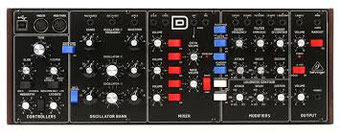
( -LEFT ) THE BEHRINGER "D"
I think most would consider Behringer's "D" to be the SE-02's foremost competitor. Having owned a "D" for a short time I'd agree. They both cover a lot of the same sonic ground. However, since I ditched my "D" ( -didn't want to risk voiding it's warranty trying to calibrate it's "drifty" oscillators myself ), I don't think it fair to comment as I was hearing the "D" at it's worst ( i.e: with un-calibrated oscillators ).
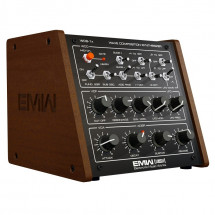
( -RIGHT ) ELECTRONIC MUSIC WORKS' "WCS-1x" The Brazilian made WCS-1x "Wave Composition Synthesizer", recently upgraded to the WCS-X completely outclasses the SE-02! Surprisingly, even with it's digital oscillator ( -the remainder of it's signal path being discrete analog ), the "WCS-X" has a convincingly "Moog-like" sound. None of the SE-02's "hyped" irritating "faux analog" pretenses. The "WCS-1x/ WCS-X's " warm, musical and beefy sound is about as authentically "old-school" as you'll find in this price range. I liked it's full-bodied "old-school" sound so much
I bought a "pair" of them for myself! If you want to experience "analog heaven" on a beer-budget connect an Arturia "Key Step" keyboard controller's MIDI output to a MIDI Solutions "QuadraThru" ( 1-in-4-out ) MIDI splitter box so you can program and play "combined patches" on a pair of these puppies. Absolutely incredible sounding! You can read my full review of the older Electronic Music Work's "WCS-1x" here:
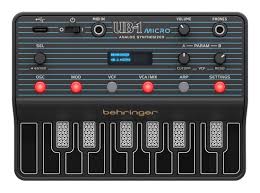
( -LEFT ) BEHRINGER'S "UB-1" MICRO SYNTYHESIZER
New on the scene: Behringer's ( new ) "UB-1 Micro" Synth. This $70.00 beast is based upon Cool Audio's V3396 and V3397 IC chips ( - a knock-off of CEM's 3396 "single voice synth on
a chip" IC's ) and sounds sooooooooooooooo much beefier and "analog" than the SE-02. There's no comparison! It features a great arpeggiator, patch memory and on-panel programming. ( -ABOVE ) BEHRINGER"S "UB-1 MICRO" You could literally buy FIVE of these tiny beasts and have money left over ( - compared to buying a single SE-02! ). I wish Behringer would plop 5-8 of these V3396/ 97's into a low cost polysynth! It's amazing how good this $70.00 micro synth sounds. WAY better than the SE-02!
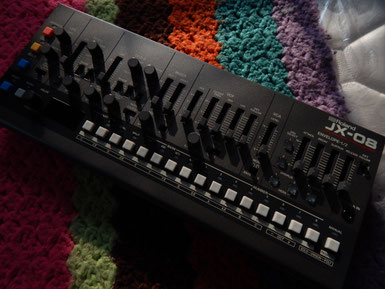
( -RIGHT ) ROLAND BOUTIQUE JX-08
Roland's JX-08, utilizing their ABM/ Zen Core Modeling - affords up to 20-voice polyphony. This unit is surprisingly "analog" sounding despite using modeling. Again, far outclassing the SE-02's "faux analog" sound. Built-in two part sequencer, arpeggiator and boasting a slew of built-in effects + patch memory! A far better value and better sounding than the
SE-02!
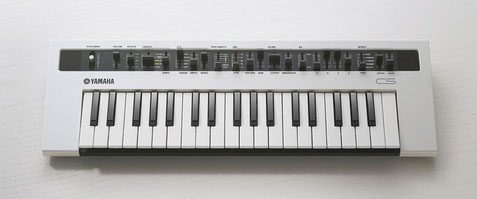
( -RIGHT ) YAMAHA'S REFACE "CS" SYNTHESIZER Yamaha's svelte ReFace "CS" ( -with it's compact, sturdily built 3-octave mini-keyboard ) is a viable competitor though it doesn't offer anywhere near the SE-02's sonic features. What IT DOES have that the SE-02 sorely lacks is great sound-quality. Well, let me clarify that a bit. The"CS" offers ( 5 ) different Oscillator Modes. Of those, the bottom "Supersaw" Oscillator Mode ( -with it's two multi-sawtooth waves and pulse-width modulated square wave ) provides an incredible bass foundation. The SE-02 can't come close to matching it. Using this "Supersaw" mode and the "CS's" filter yields gorgeously fat and rich sounds. Problem is, the "CS" is a "one trick pony". This "Supersaw" Oscillator Mode is the ONLY oscillator mode that sounds good. The other four modes could've been left off altogether and I'd have never missed them. And using this one mode makes for a rather limited sonic palette.
In it's favor, the Yamaha "CS's" beautifully compact size, design and small "footprint" make it perfect for "on-the-go" mobility ( -as does it's 6 x AA powering option ). It's 3-octave mini-keyboard has a deluxe feeling keybed rare in it's price range. In fact, these aspects of the ReFace "CS" inspired me to design the "Grab n' Go Workstation Keyboard" design pictured below -which packages a full-featured workstation into a chassis having the identical dimensions, weight and AC/DC mobility of the "CS". You can read more about it by clicking on this "Grab n' Go Workstation" link and scrolling down the page. If you'd like to read my full review of the "CS" click the following "Yamaha CS" link.
*CAST your VOTE!
The "Grab & Go" Workstation Synth... Would you buy one if it was made?
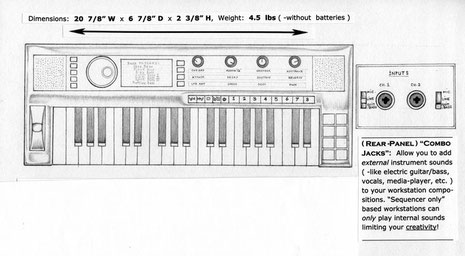
( -LEFT ) MY "GRAB & GO" WORKSTATION KEYBOARD DESIGN.
Based upon Yamaha's svelte "ReFace" line of keyboards. Same dimensions, weight and three octave mini-keyboard. Hopefully, some day this workstation will be made.
Combining the lightweight, svelte dimensions of Yamaha's "ReFace" line of keyboards with Roland's
groundbreaking ( 2010 ) Juno Gi Workstation, the "Grab & Go" combines go anywhere mobility with
eight tracks of onboard digital recording ( -overcoming the limitations of conventional "sequencer based" workstations). Click on the following link for details: "Grab & Go Workstation" Keyboard Scroll down the
page to read more about this proposed workstation keyboard.

ATTENTION: Small-format Synthesists!
See how you can become a part of our upcoming documentary film and book about the Tiny Synth movement:
If you enjoy using small format synths like ROLAND'S "BOUTIQUES", KORG'S "VOLCA'S ( or ) OTHER small synths to record your own ( original ) spacerock, progressive rock or electronic-music, we may want to include some info about you in our book. To
find out more - click on the link above.
SE-02 Conclusions:
So, what can I say about the Roland/ Studio Electronics' SE-02? Honestly, I thought I'd be writing a very positive review on it based upon my initial impressions. However, once I actually had one in front of me to test my first impressions were dashed by it's underwhelming sound, worrisome build-quality and less than optimal implementation of features ( -companies shouldn't rely so heavily upon firmware updates to "get it right" after the fact! ). The SE-02's less than intuitive design and irksome operation ( -as described above ) didn't help matters either.
So, I can't give the SE-02 my full-throated endorsement. There are just too many features that could've been designed and implemented better. And again, the quality of parts ( i.e: knobs, switches, 1/8" mini-jacks, etc. ) leaves much to be desired -especially considering the unit's list price. In conclusion, I'd recommend giving the SE-02 a "pass" and checking out some of the "alternatives" I've listed above. If you're after genuine "old-school" analog sound I think ANY of these "alternatives" will get you closer to the mark.
- END OF REVIEW -